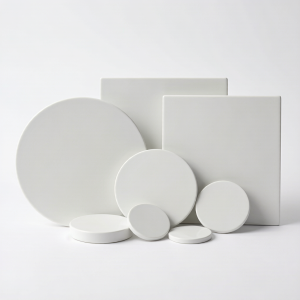
Silicon Nitride Ceramic Plates are flat parts used as wear plates, insulating barriers, substrate blanks, heat spreaders and precision reference surfaces.
Silicon nitride plates are chosen where a plate carries load as well as heat, in welding fixtures, press tooling and hot forming dies. The material holds strength at temperature and resists the thermal shock of repeated contact with hot work.
Silicon nitride pairs high strength of 700-900 MPa with 6-8 MPa·m½ toughness at only 3.2 g/cm³. It survives the thermal shock that cracks most ceramics, resists molten non-ferrous metals, and its fine grain allows bearing-grade finishes.
It is among the more expensive options, and unlike SiC its thermal conductivity is a modest 25-35 W/m·K, so it is specified for mechanical reliability rather than heat spreading.
Specifications
| Maximum size | up to 400×400 mm |
| Thickness | 0.3-30 mm |
| Flatness | 0.005 mm per 100 mm |
| Parallelism | 0.01 mm |
| Surface finish | Ra 0.4 µm ground, Ra 0.2 µm lapped |
| Holes and slots | ground, drilled or laser cut |
| Edges | square, chamfered or radiused |
Silicon Nitride Properties
| Composition | Gas-pressure sintered silicon nitride |
| Density | 3.20-3.25 g/cm³ |
| Vickers hardness | 1500-1600 HV |
| Flexural strength | 700-900 MPa |
| Fracture toughness | 6-8 MPa·m½ |
| Max. service temperature | 1000°C (1200°C short term) |
| Thermal conductivity | 25-35 W/m·K |
| Thermal expansion (20-1000°C) | 3.2 ×10⁻⁶/K |
Machining and Tolerances
Plates are pressed or tape cast, fired, then surface ground and lapped. Thin large plates are the most likely to warp, so material is removed in equal amounts from both faces to keep the stress balanced, and grinding is followed by a relaxation step before the final passes.
Where It Is Used
- Wear plates and chute liners in bulk handling
- Electrical insulation barriers in switchgear and heaters
- Hot platens and press tooling in electronics manufacturing
- Vacuum chuck and metering surfaces in semiconductor equipment
- Precision reference and gauge blocks in metrology
Frequently Asked Questions
How flat can a large ceramic plate be held?
0.005 mm per 100 mm is the working standard for lapped plates. Larger areas are harder, and above 300×300 mm we generally specify flatness over a defined area rather than across the whole plate.
Will it warp when I bolt it down?
It can. A plate that is flat when unclamped will follow a distorted mounting face, so we recommend a relieved or lapped mounting surface, evenly torqued fixings and a compliant interlayer.