Material

Titania Ceramics

Titania (TiO₂) ceramics occupy a niche where high dielectric constant, voltage-withstanding capability and moderate mechanical properties intersect. They are most commonly encountered as capacitor substrates, varistor bodies, voltage-dependent resistors and…

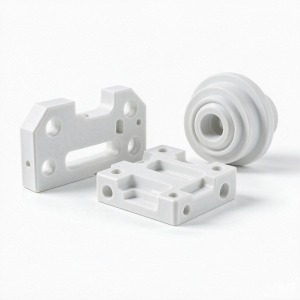
Custom Precision Ceramic Parts

Titania (TiO₂) ceramics occupy a niche where high dielectric constant, voltage-withstanding capability and moderate mechanical properties intersect. They are most commonly encountered as capacitor substrates, varistor bodies, voltage-dependent resistors and microwave dielectric resonators.

Beyond electronics, titania finds use as a catalyst support (its surface chemistry is highly active), as a wear-resistant coating precursor, and in certain biomedical applications where its biocompatibility and photocatalytic activity are advantageous. Pure rutile-phase titania has a dielectric constant exceeding 100, making it valuable for miniaturising capacitive components.

Typical Properties

Indicative ranges — confirm grade and test conditions before design commitment.

PropertyIndicative Value
CompositionTitanium dioxide
Density4.00-4.20 g/cm3
Vickers hardness800-1000 HV
Flexural strength100-150 MPa
Fracture toughness2-3 MPa.m1/2
Max. service temperature1000 C
Thermal conductivity3-4 W/m.K
Thermal expansion (20-1000 C)8-9 x10⁻⁶/K
Potential Advantages

Very high dielectric constant (rutile ε_r > 100); good voltage breakdown strength; chemically stable in oxidising environments; photocatalytic activity (self-cleaning surfaces); biocompatible.

Design Considerations

Dielectric properties vary strongly with crystal phase (rutile vs. anatase), grain size and dopants — specify the electrical requirements precisely. Mechanical strength is modest, so titania components are normally protected from mechanical load by their assembly design.

Limitations & Trade-offs

Low fracture toughness and strength compared to structural ceramics; dielectric properties sensitive to microstructure and processing; not suitable for high-temperature structural applications (>600 °C long-term); electrical properties drift with temperature.