


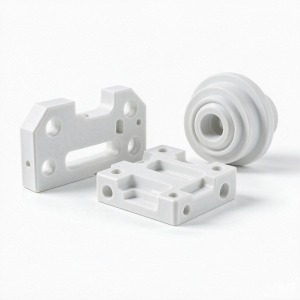
Ceramic substrates carry and insulate an electronic circuit. They are the base on which a conductor pattern is deposited, so the surface is the product.
Aluminium nitride substrates are used where heat flux is the limiting factor, in IGBT modules, RF power devices and high-brightness LED arrays. Conductivity of 170-200 W/m·K removes the heat that would otherwise throttle the device.
Aluminium nitride is the thermal-management ceramic. Conductivity of 170-200 W/m·K rivals metals while the material stays an electrical insulator, and its 4.5 ×10⁻⁶/K expansion sits close to silicon, which is why it underpins power electronics substrates.
It degrades in humid or alkaline conditions unless protected, its flexural strength of 300-350 MPa is only moderate, and it costs considerably more than alumina.
Specifications
| Thickness | 0.25-2.0 mm |
| Maximum size | up to 200×200 mm |
| Thickness tolerance | ±0.02 mm |
| Camber | under 0.1% of length |
| Surface finish | Ra 0.2-0.8 µm |
| Vias | drilled or laser cut, from 0.1 mm |
| Metallisation | thick film, thin film or DBC available |
Aluminium Nitride Properties
| Composition | Aluminium nitride |
| Density | 3.26 g/cm³ |
| Vickers hardness | 1100-1200 HV |
| Flexural strength | 300-350 MPa |
| Fracture toughness | 2.5-3.5 MPa·m½ |
| Max. service temperature | 1000°C |
| Thermal conductivity | 170-200 W/m·K |
| Thermal expansion (20-1000°C) | 4.5 ×10⁻⁶/K |
Machining and Tolerances
Substrates are tape cast or rolled to thickness, fired, then lapped or ground to finished gauge. Vias are drilled or laser cut, and where a circuit needs it the surface is metallised with thick film, thin film or direct bonded copper before delivery.
Where It Is Used
- Power module and IGBT base plates
- LED and high-brightness die attach substrates
- RF and microwave circuit carriers
- Sensor and heater element bases
- Insulated metal substrate replacement in power conversion
Frequently Asked Questions
Which substrate material should I choose?
Alumina for general use and lowest cost, aluminium nitride where heat has to move, and silicon nitride where the circuit sees thermal cycling and mechanical load. We base the choice on heat flux and cycling duty rather than on conductivity alone.
Do you supply metallised substrates?
Yes. Thick film, thin film and direct bonded copper are available, and we can supply either the blank or the finished metallised panel depending on your process.