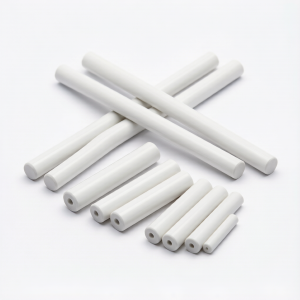
Silicon Carbide Ceramic Rods are cylindrical parts used to locate, guide, space or insulate. The geometry is simple; the tolerance requirements rarely are.
Silicon carbide rods suit furnace fixtures and high-temperature supports, where conductivity of 120-200 W/m·K spreads heat evenly along the length instead of leaving hot spots at the ends. They hold their shape through the rapid temperature changes that would crack a lower-conductivity ceramic.
Silicon carbide is chosen when a part must survive abrasion, high temperature and thermal shock at the same time. Hardness reaches 2200-2500 HV, thermal conductivity of 120-200 W/m·K is several times that of steel, and expansion of 4.0 ×10⁻⁶/K keeps it in shape through fast temperature swings.
It is brittle and electrically semiconducting, so it is not used where electrical isolation matters, and its hardness makes diamond grinding the only practical finishing route.
Specifications
| Diameter range | 1-60 mm |
| Length | up to 500 mm |
| Diameter tolerance | ±0.01 mm standard, ±0.002 mm ground |
| Straightness | 0.02 mm per 100 mm |
| Surface finish | Ra 0.4 µm as ground, Ra 0.05 µm polished |
| End configuration | chamfered, radiused, flat, stepped or threaded |
Silicon Carbide Properties
| Composition | Sintered silicon carbide (SSiC) |
| Density | 3.10-3.15 g/cm³ |
| Vickers hardness | 2200-2500 HV |
| Flexural strength | 400-500 MPa |
| Fracture toughness | 3-4 MPa·m½ |
| Max. service temperature | 1400°C in air (1600°C inert) |
| Thermal conductivity | 120-200 W/m·K |
| Thermal expansion (20-1000°C) | 4.0 ×10⁻⁶/K |
Machining and Tolerances
Rods are centreless ground from extruded or isostatically pressed stock, then lapped or polished to finish. Straightness is the hardest requirement on long parts, and we check it along the full length rather than at the two ends, because a bowed rod can measure in tolerance at both ends and still bind in service.
Where It Is Used
- Guide and locating pins in fixtures and assembly equipment
- Insulating shafts in furnaces, heaters and analytical instruments
- Plunger stems and valve push rods in metering pumps
- Wear rollers and thread guides in textile and wire machinery
- Spacers and standoffs in high-voltage and vacuum assemblies
Frequently Asked Questions
How straight can a ceramic rod be made?
Straightness is held to 0.02 mm per 100 mm as a working standard. We measure along the full length rather than at the two ends, because that is the condition that decides whether the rod will bind in a bore.
Can you put a shoulder, a thread or a cross hole on a ceramic rod?
Yes. Steps, shoulders and cross holes are ground into the blank. Sharp internal corners are avoided in the design because they concentrate stress in a brittle material, so a radius is always used instead.