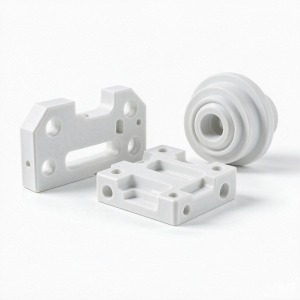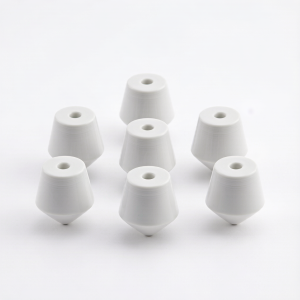
Ceramic nozzles meter, direct or atomise a fluid, a gas or an abrasive stream. The orifice is the whole point of the part.
Silicon nitride nozzles are used in high-velocity and thermally cycled service such as burner nozzles and welding torch tips. The material resists both the thermal shock of ignition and the impact of particulate carried in the gas stream.
Silicon nitride pairs high strength of 700-900 MPa with 6-8 MPa·m½ toughness at only 3.2 g/cm³. It survives the thermal shock that cracks most ceramics, resists molten non-ferrous metals, and its fine grain allows bearing-grade finishes.
It is among the more expensive options, and unlike SiC its thermal conductivity is a modest 25-35 W/m·K, so it is specified for mechanical reliability rather than heat spreading.
Specifications
| Orifice diameter | 0.1-10 mm |
| Orifice tolerance | ±0.005 mm |
| Outer diameter | 5-60 mm |
| Length | up to 150 mm |
| Orifice concentricity | 0.01 mm |
| Bore finish | Ra 0.4 µm |
| Entry | radiused, conical or sharp edge |
Silicon Nitride Properties
| Composition | Gas-pressure sintered silicon nitride |
| Density | 3.20-3.25 g/cm³ |
| Vickers hardness | 1500-1600 HV |
| Flexural strength | 700-900 MPa |
| Fracture toughness | 6-8 MPa·m½ |
| Max. service temperature | 1000°C (1200°C short term) |
| Thermal conductivity | 25-35 W/m·K |
| Thermal expansion (20-1000°C) | 3.2 ×10⁻⁶/K |
Machining and Tolerances
Nozzles are turned and ground from solid stock rather than cast, because bore and outside have to be concentric. Orifices below about 0.5 mm are produced by precision drilling or laser, and the entry is radiused rather than sharp so the flow does not separate.
Where It Is Used
- Abrasive blasting and slurry spray nozzles
- Burner and plasma torch nozzles
- Atomising nozzles for coating and humidification
- Precision dispensing tips in fluid handling
- High-wear spray tips in scrubber and desulphurisation systems
Frequently Asked Questions
How small an orifice can you produce?
Down to about 0.1 mm depending on material and length. Small deep holes are the hardest features to hold, so we normally discuss the length-to-diameter ratio before quoting.
Which material wears longest in abrasive service?
Boron carbide then silicon carbide for pure abrasion, and silicon nitride where impact and thermal shock are present too. We match the material to the abrasive, the velocity and the fluid rather than defaulting to the hardest option.