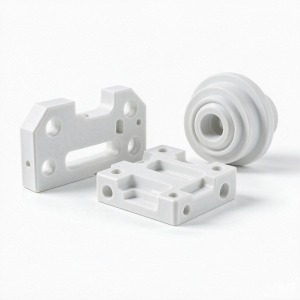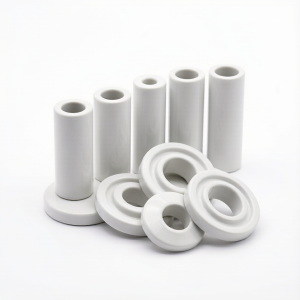
Ceramic sleeves and bushings take the wear between a shaft and its housing. They are specified where a bronze or polymer bearing would wear out, seize or contaminate the product.
Silicon nitride sleeves suit bearings and bushes that see shock loading and marginal lubrication. The low 3.2 g/cm³ density cuts centrifugal loading at speed, and the toughness tolerates the vibration that cracks a ceramic bush in a rough-running machine.
Silicon nitride pairs high strength of 700-900 MPa with 6-8 MPa·m½ toughness at only 3.2 g/cm³. It survives the thermal shock that cracks most ceramics, resists molten non-ferrous metals, and its fine grain allows bearing-grade finishes.
It is among the more expensive options, and unlike SiC its thermal conductivity is a modest 25-35 W/m·K, so it is specified for mechanical reliability rather than heat spreading.
Specifications
| Inner diameter | 5-120 mm |
| Outer diameter | 8-150 mm |
| Length | up to 200 mm |
| Bore cylindricity | 0.005 mm |
| Bore finish | Ra 0.4 µm, honed Ra 0.2 µm |
| Outer diameter tolerance | ±0.01 mm |
| Fit | clearance matched to shaft material and duty |
Silicon Nitride Properties
| Composition | Gas-pressure sintered silicon nitride |
| Density | 3.20-3.25 g/cm³ |
| Vickers hardness | 1500-1600 HV |
| Flexural strength | 700-900 MPa |
| Fracture toughness | 6-8 MPa·m½ |
| Max. service temperature | 1000°C (1200°C short term) |
| Thermal conductivity | 25-35 W/m·K |
| Thermal expansion (20-1000°C) | 3.2 ×10⁻⁶/K |
Machining and Tolerances
Sleeves are ground on the outside and honed or internally ground to bore. We size the bore to the shaft you run rather than to a nominal dimension, because ceramic and steel expand at different rates and clearance at room temperature is not clearance at working temperature.
Where It Is Used
- Pump shaft sleeves and wear bushes in chemical and water service
- Insulating bushes through furnace walls and heated platens
- Guide bushes in food, pharmaceutical and textile machinery
- Bushings for high-temperature conveyors and kiln cars
- Electrical isolation sleeves in motor and generator assemblies
Frequently Asked Questions
How do you size the bore for a metal shaft?
We work from your shaft diameter and maximum working temperature, then calculate the clearance from the expansion coefficients of the two materials. A bore that fits at 20°C can grip at 300°C if it is sized purely nominally.
Can the sleeve be retained without adhesive?
Press fitting works where the housing is steel and the interference is modest. Where the housing is also ceramic or the duty involves thermal cycling, we prefer mechanical retainment or a compliant interlayer so differential expansion cannot crack the sleeve.