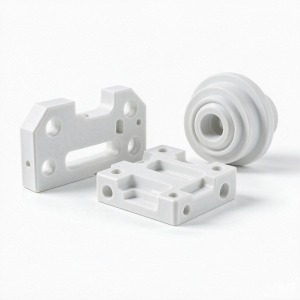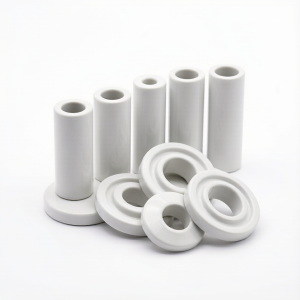
Ceramic sleeves and bushings take the wear between a shaft and its housing. They are specified where a bronze or polymer bearing would wear out, seize or contaminate the product.
Silicon carbide sleeves are used in the hardest pump duties, including hot fluids and slurries carrying hard particles. The high conductivity also helps draw frictional heat out of the bush, which is what keeps the running clearance stable under heavy load.
Silicon carbide is chosen when a part must survive abrasion, high temperature and thermal shock at the same time. Hardness reaches 2200-2500 HV, thermal conductivity of 120-200 W/m·K is several times that of steel, and expansion of 4.0 ×10⁻⁶/K keeps it in shape through fast temperature swings.
It is brittle and electrically semiconducting, so it is not used where electrical isolation matters, and its hardness makes diamond grinding the only practical finishing route.
Specifications
| Inner diameter | 5-120 mm |
| Outer diameter | 8-150 mm |
| Length | up to 200 mm |
| Bore cylindricity | 0.005 mm |
| Bore finish | Ra 0.4 µm, honed Ra 0.2 µm |
| Outer diameter tolerance | ±0.01 mm |
| Fit | clearance matched to shaft material and duty |
Silicon Carbide Properties
| Composition | Sintered silicon carbide (SSiC) |
| Density | 3.10-3.15 g/cm³ |
| Vickers hardness | 2200-2500 HV |
| Flexural strength | 400-500 MPa |
| Fracture toughness | 3-4 MPa·m½ |
| Max. service temperature | 1400°C in air (1600°C inert) |
| Thermal conductivity | 120-200 W/m·K |
| Thermal expansion (20-1000°C) | 4.0 ×10⁻⁶/K |
Machining and Tolerances
Sleeves are ground on the outside and honed or internally ground to bore. We size the bore to the shaft you run rather than to a nominal dimension, because ceramic and steel expand at different rates and clearance at room temperature is not clearance at working temperature.
Where It Is Used
- Pump shaft sleeves and wear bushes in chemical and water service
- Insulating bushes through furnace walls and heated platens
- Guide bushes in food, pharmaceutical and textile machinery
- Bushings for high-temperature conveyors and kiln cars
- Electrical isolation sleeves in motor and generator assemblies
Frequently Asked Questions
How do you size the bore for a metal shaft?
We work from your shaft diameter and maximum working temperature, then calculate the clearance from the expansion coefficients of the two materials. A bore that fits at 20°C can grip at 300°C if it is sized purely nominally.
Can the sleeve be retained without adhesive?
Press fitting works where the housing is steel and the interference is modest. Where the housing is also ceramic or the duty involves thermal cycling, we prefer mechanical retainment or a compliant interlayer so differential expansion cannot crack the sleeve.