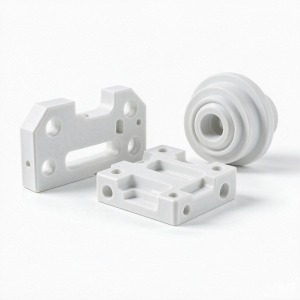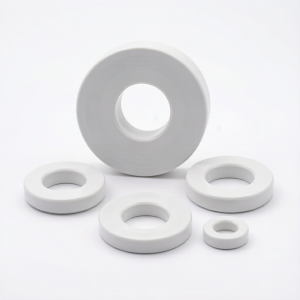
Ceramic rings and seal rings serve as wearing seats, seal faces, spacers and bearing races. Most are simple in outline and extremely demanding on the two flat faces.
Silicon nitride rings are used as bearing races and seal rings where the duty combines load, speed and thermal shock. The 6-8 MPa·m½ toughness matters most here, because a race that chips under a rolling element takes the whole assembly with it.
Silicon nitride pairs high strength of 700-900 MPa with 6-8 MPa·m½ toughness at only 3.2 g/cm³. It survives the thermal shock that cracks most ceramics, resists molten non-ferrous metals, and its fine grain allows bearing-grade finishes.
It is among the more expensive options, and unlike SiC its thermal conductivity is a modest 25-35 W/m·K, so it is specified for mechanical reliability rather than heat spreading.
Specifications
| Outer diameter | 5-200 mm |
| Inner diameter | 3-180 mm |
| Height | 2-40 mm |
| Wall thickness | 1-20 mm |
| Face flatness | 0.005 mm |
| Parallelism | 0.01 mm |
| Seal face finish | Ra 0.05-0.1 µm lapped |
Silicon Nitride Properties
| Composition | Gas-pressure sintered silicon nitride |
| Density | 3.20-3.25 g/cm³ |
| Vickers hardness | 1500-1600 HV |
| Flexural strength | 700-900 MPa |
| Fracture toughness | 6-8 MPa·m½ |
| Max. service temperature | 1000°C (1200°C short term) |
| Thermal conductivity | 25-35 W/m·K |
| Thermal expansion (20-1000°C) | 3.2 ×10⁻⁶/K |
Machining and Tolerances
Rings are cut from pressed or extruded tube stock or pressed individually, then both faces are ground and lapped together so they stay parallel. Seal faces are lapped to Ra 0.05-0.1 µm, and we inspect flatness under monochromatic light rather than with a dial indicator.
Where It Is Used
- Mechanical seal faces and mating rings in pumps and mixers
- Wear rings and throttling discs in valve trim
- Insulating spacers in high-voltage stacks
- Bearing races for corrosive or high-temperature service
- Precision spacers and shims in optical and metrology assemblies
Frequently Asked Questions
How flat can a seal face be made?
Lapped seal faces are held to 0.005 mm flatness or better, verified under monochromatic light. Below about 0.3 light bands the result depends more on the lapping method than on the material.
Do you supply matched seal pairs?
Yes. A rotating ring and its stationary seat are lapped as a pair so the two faces are matched, which shortens run-in and reduces the risk of initial leakage.