


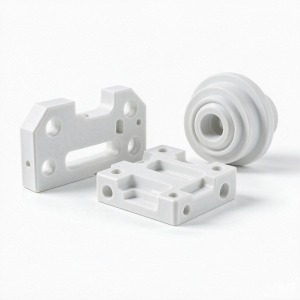
Custom Alumina Ceramic Parts are made to your drawing rather than to a catalogue shape: complex outlines, intersecting bores, thin walls and asymmetrical features that no standard shape covers.
Custom alumina parts are the starting point for most bespoke work, because alumina grinds to close tolerance at the lowest cost and is available across every forming route. Unless the duty demands otherwise, it is usually the right first choice.
Alumina is the default engineering ceramic. It combines high hardness (1500-1700 HV) with good electrical insulation and chemical inertness at a lower cost than most technical ceramics, and in 99.8% purity it holds strength to 1700°C while resisting most acids, alkalis and solvents.
It is not the toughest option. At 3-4 MPa·m½ fracture toughness, sharp impact or point loading will chip an edge, so chamfers and radii belong in the drawing from the start.
Specifications
| Process route | pressing, CIP, injection moulding or extrusion |
| Finishing | diamond grinding, lapping, honing |
| Dimensional tolerance | ±0.01 mm, ±0.002 mm on ground features |
| Surface finish | Ra 0.4 µm ground, Ra 0.05 µm polished |
| Features | bores, slots, threads, tapers, pockets |
| Quantity | single prototypes to production volumes |
| Drawing formats | DXF, STEP, IGES, PDF |
Alumina Properties
| Composition | Aluminium oxide, 96% / 99.5% / 99.8% |
| Density | 3.70-3.95 g/cm³ |
| Vickers hardness | 1500-1700 HV |
| Flexural strength | 300-400 MPa |
| Fracture toughness | 3-4 MPa·m½ |
| Max. service temperature | 1500°C (99.8%: 1700°C) |
| Thermal conductivity | 25-35 W/m·K |
| Thermal expansion (20-1000°C) | 8.0 ×10⁻⁶/K |
Machining and Tolerances
Complex parts are near-net shaped by pressing, injection moulding or isostatic pressing, then ground with diamond tooling to the finished features. Green machining before firing is used where it saves grinding time, and we always advise on which features are worth holding and which will drive cost without adding function.
Where It Is Used
- Semiconductor and vacuum equipment components
- Fixtures and nests for welding, brazing and assembly
- Analytical and medical instrument parts
- Wear components for packaging and converting machinery
- High-voltage and high-frequency insulators
Frequently Asked Questions
What tolerance should I put on the drawing?
Hold tolerance only on features that matter. A blanket ±0.01 mm across a complex part can double or treble the cost without improving function, so we mark the functional features and leave the rest open.
Can you help with the design before quoting?
Yes, and it usually saves money. We review draft geometry for wall thickness, sharp corners and features that will not grind cleanly, then suggest changes before the drawing is frozen.