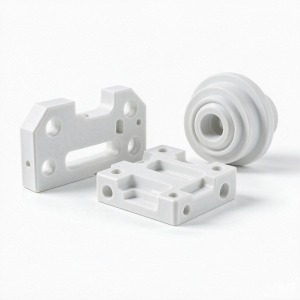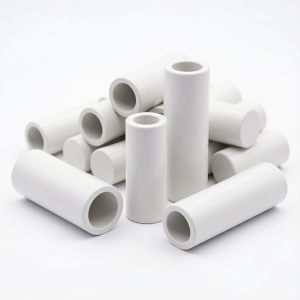
Ceramic tubes protect, isolate and carry. They serve as thermocouple sheaths, furnace muffles, insulating bushes and fluid paths where metal would corrode, creep or conduct.
Boron nitride tubes handle molten metal and glass contact, where the low wetting angle stops material bonding to the bore. They are standard as break rings in continuous casting and in crucible assemblies, and being machinable they are often modified after delivery.
Hot-pressed boron nitride is the softest ceramic here at roughly Mohs 2, and the one that can be machined with ordinary carbide tooling. It is chemically inert to molten metals that barely wet it, stays stable to 1000°C in air and 2000°C in inert atmospheres, and remains an electrical insulator.
Its hot-pressed form carries low flexural strength of 60-100 MPa and it is slowly attacked by moisture, so it is used where release, insulation or vacuum compatibility matter more than load carrying.
Specifications
| Outer diameter | 3-150 mm |
| Inner diameter | 1-120 mm |
| Length | up to 600 mm |
| Minimum wall thickness | 0.5 mm |
| Concentricity | 0.02 mm |
| Bore finish | Ra 0.4 µm, honed Ra 0.2 µm |
| Ends | square cut, chamfered, flanged or closed one end |
Boron Nitride Properties
| Composition | Hot-pressed hexagonal boron nitride |
| Density | 2.00-2.20 g/cm³ |
| Vickers hardness | 200-300 HV (Mohs approx. 2) |
| Flexural strength | 60-100 MPa |
| Fracture toughness | 2-3 MPa·m½ |
| Max. service temperature | 1000°C in air, 2000°C inert |
| Thermal conductivity | 30-60 W/m·K (in-plane) |
| Thermal expansion (20-1000°C) | 1-3 ×10⁻⁶/K |
Machining and Tolerances
Tubes are extruded, isostatically pressed or slip cast depending on size and quantity, then ground on the outside and honed internally. Long thin-wall tubes are the most distortion-prone parts we make, so we rough grind, allow the part to relax, then finish grind.
Where It Is Used
- Thermocouple protection sheaths and furnace muffles
- Insulating bushes through heated panels and vacuum chambers
- Fluid and slurry transport in corrosive or abrasive service
- Lamp, laser and UV equipment bodies
- High-voltage insulators and standoffs
Frequently Asked Questions
What is the thinnest wall you can produce?
0.5 mm is the practical floor for most materials and lengths. Below that, yield drops sharply during firing and grinding, so we review the drawing and usually suggest thickening the wall or shortening the tube.
Can you supply closed-end tubes?
Yes. Closed one end, hemispherical closed ends and reduced-tip ends for thermocouple sheaths are all produced, either formed during shaping or ground after firing.