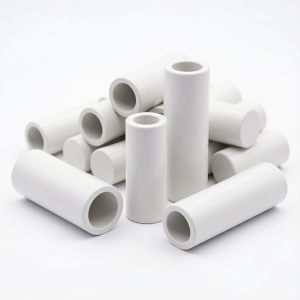
Ceramic tubes protect, isolate and carry. They serve as thermocouple sheaths, furnace muffles, insulating bushes and fluid paths where metal would corrode, creep or conduct.
Aluminium nitride tubes are used where a tube has to pass heat while blocking electricity, in heater element carriers and semiconductor tool gas paths. Conductivity of 170-200 W/m·K in an electrical insulator is a combination no other common ceramic provides.
Aluminium nitride is the thermal-management ceramic. Conductivity of 170-200 W/m·K rivals metals while the material stays an electrical insulator, and its 4.5 ×10⁻⁶/K expansion sits close to silicon, which is why it underpins power electronics substrates.
It degrades in humid or alkaline conditions unless protected, its flexural strength of 300-350 MPa is only moderate, and it costs considerably more than alumina.
Specifications
| Outer diameter | 3-150 mm |
| Inner diameter | 1-120 mm |
| Length | up to 600 mm |
| Minimum wall thickness | 0.5 mm |
| Concentricity | 0.02 mm |
| Bore finish | Ra 0.4 µm, honed Ra 0.2 µm |
| Ends | square cut, chamfered, flanged or closed one end |
Aluminium Nitride Properties
| Composition | Aluminium nitride |
| Density | 3.26 g/cm³ |
| Vickers hardness | 1100-1200 HV |
| Flexural strength | 300-350 MPa |
| Fracture toughness | 2.5-3.5 MPa·m½ |
| Max. service temperature | 1000°C |
| Thermal conductivity | 170-200 W/m·K |
| Thermal expansion (20-1000°C) | 4.5 ×10⁻⁶/K |
Machining and Tolerances
Tubes are extruded, isostatically pressed or slip cast depending on size and quantity, then ground on the outside and honed internally. Long thin-wall tubes are the most distortion-prone parts we make, so we rough grind, allow the part to relax, then finish grind.
Where It Is Used
- Thermocouple protection sheaths and furnace muffles
- Insulating bushes through heated panels and vacuum chambers
- Fluid and slurry transport in corrosive or abrasive service
- Lamp, laser and UV equipment bodies
- High-voltage insulators and standoffs
Frequently Asked Questions
What is the thinnest wall you can produce?
0.5 mm is the practical floor for most materials and lengths. Below that, yield drops sharply during firing and grinding, so we review the drawing and usually suggest thickening the wall or shortening the tube.
Can you supply closed-end tubes?
Yes. Closed one end, hemispherical closed ends and reduced-tip ends for thermocouple sheaths are all produced, either formed during shaping or ground after firing.