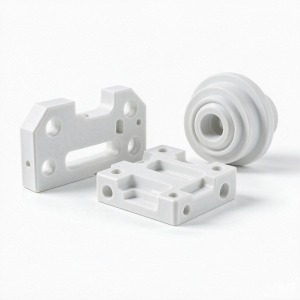
Yes. Share your drawing and operating conditions and we review geometry, tolerance and function with you.
We focus on custom parts made to drawing. Some geometries can be adapted from prior projects.
Material selection usually comes down to four questions: operating temperature, mechanical loading, chemical environment, and whether electrical or thermal behaviour matters.
Alumina is the default for wear, insulation and general industrial service at reasonable cost. Zirconia is chosen where impact or fracture toughness matters. Silicon carbide suits high temperature, high thermal conductivity and aggressive wear. Silicon nitride handles thermal shock and structural load. Aluminum nitride is used when heat must be removed while remaining electrically insulating. Boron nitride and machinable glass ceramic are chosen when the geometry needs to be milled without tooling.
Send us the operating conditions and we will narrow it with you rather than asking you to pick from a datasheet.
Most ceramic parts are produced by net-shape forming and then finished by grinding, lapping or polishing. As-sintered dimensions carry a wider band; anything that must fit or seal is finished after firing.
Tell us which dimensions are functional and which are not. Parts are commonly specified with tight control on only two or three features, and holding everything to the tightest band is the fastest way to make an affordable part expensive. We will say clearly what is achievable on each feature before you commit.
Lead time depends on whether tooling is required and how much post-sinter finishing the part needs.
Parts that can be produced from standard tooling and need only light finishing move fastest. Parts requiring new dies, or extensive grinding and lapping, take longer. Prototype and small-batch routes are usually quicker to start than full production tooling.
We give a specific figure against your drawing rather than a general range, because the finishing route drives the schedule more than the material does.
We support prototype, small-batch and production volumes. There is no fixed minimum that applies to every part.
Very low quantities are usually produced by machining from stock or from a near-net blank, which avoids tooling cost. Higher volumes justify dedicated tooling and bring the unit cost down. We will indicate where that crossover sits for your part so you can decide whether to tool now or later.
Yes. Send the sample and we can measure it and reconstruct the geometry for production.
Be aware that a worn sample reproduces the worn condition, not the original design. Where a part has worn in service, tell us which surfaces are wear surfaces so we can reconstruct the intended geometry rather than the used one.
We work from standard 2D drawings (PDF, DWG, DXF) and 3D models (STEP, IGES, SLDPRT).
A 3D model speeds up feasibility review considerably. Whichever format you send, please include material, quantity, and any critical dimensions or surface finish requirements marked on the drawing.
Yes, but the joining method needs to be designed rather than selected afterwards.
Ceramic and metal expand at very different rates, so rigid fixing usually fails. Common routes are mechanical clamping with compliant intermediate layers, shrink fitting, brazing with an appropriate metallisation, or adhesive bonding. We will recommend a route based on your operating temperature and load, and flag where an assembly is better redesigned as a single ceramic body.
Four things, in rough order of impact: dimensional tolerance, surface finish requirement, geometry complexity, and quantity.
Tolerance and finish drive cost because they determine how much grinding and lapping the part needs after firing. Tolerances specified on non-functional features are the most common source of unnecessary cost. If budget is fixed, tell us which features genuinely matter and we will relax the rest.
Yes, and we recommend it for any part with demanding geometry or an unproven material choice.
Prototype parts are normally produced by machining rather than dedicated tooling, so the prototype route does not commit you to tooling cost. Where the production route differs from the prototype route, we will say so explicitly so you are not surprised by a change in behaviour at volume.
Specify finish only where it affects function: sealing faces, bearing surfaces, optical or vacuum interfaces, and product-contact surfaces in semiconductor and medical service.
Specifying a fine finish across the whole part adds cost without improving performance. State the finish requirement per feature where possible. If you are unsure what the function requires, describe the operating condition and we will propose a value.
Yes. Material certification and dimensional inspection reports can be supplied with shipments.
Tell us at enquiry stage if documentation is required, since inspection requirements affect how the part is measured and scheduled. Certificates of analysis, dimensional reports and, where applicable, surface finish or flatness measurement can be included.
Ceramics are brittle and do not relieve thermal stress by yielding the way metals do, so rapid temperature change is the most common cause of unexpected failure.
Resistance varies sharply by material. Fused silica and silicon nitride tolerate rapid cycling well; alumina is moderate; large or thick sections are always more vulnerable than thin ones. Tell us the heat-up and cool-down profile, not just the peak temperature, and we will flag whether the design is at risk.
Tell us about your operating conditions and we will review material and process options with you.


